The ever changing qualifications landscape
An article to save time building student and parent understanding of the changes.

Ever since I can remember, qualifications for school students have been in a state of flux. When I was at school it was O levels and CSE’s. And I was caught in the changeover from grammar & secondary schools merging into comprehensives. Yes, I’ve been around that long. If you’ve been working in education for more than a year or two you might well be saying to yourself, is there ever a year without change?

Since coming into teaching, I’ve observed the birth of the national curriculum and all it’s subsequent changes, the introduction of GCSE’s; GNVQ’s; BTEC’s; Diplomas and T Levels. In the last few months we’ve heard of a new qualification, the V Level AND some tweaks to the T Levels. Before you start crying and bewailing more changes, I should point out the intended purpose behind these changes.
“This is national renewal in action - a skills system that prepares every young person for the jobs of the future, reduces NEET rates and drives the economic growth our country needs.”
Baroness Jacqui Smith - Skills Minister
Given the frankly terrifying news of the level of NEETs that we are currently experiencing, this is a laudable aim. However, it will undoubtably cause confusion and worry amongst parents and students. So here is some info, in an easily shared format that can help communicate the changes to these groups.
V Levels will come into use from 2027 and be the equivalent of 1 A level, thus allowing students to mix and match the academic and vocational routes if they wish.
The subjects that will be introduced are:-
In 2027
Education and early years
Finance and accounting
Digital
From 2028
Business and administration
Care services
Construction
Engineering and manufacturing
Health and science
Legal (as part of legal, finance and accounting route)
Sales, marketing and procurement
Sports, fitness and exercise science
From 2029
Agriculture, environmental and animal care
Catering and hospitality
Hair and beauty
Protective services
From 2030
Art and performing arts
Creative and design
Travel and tourism
To help parents understand the various options, I’ve put together a short post that can be sent to parents via newsletters or other means. Paid subscribers have access to a ready to print version that can be sent home with pupils or added to the school website and also a ready made presentation and a graphic, without a watermark, showing the differences. The parent post below can be shared without the graphic by free subscribers.
I do hope this helps everyone.
Understanding Post-16 Pathways: A Guide for Parents
As students approach the end of Year 11, many families begin thinking about what comes next. The good news is that there are several different routes available after age 16, and each one can lead to successful futures in higher education, apprenticeships or employment. The most important thing is choosing the pathway that best suits how a young person learns and what they are interested in.
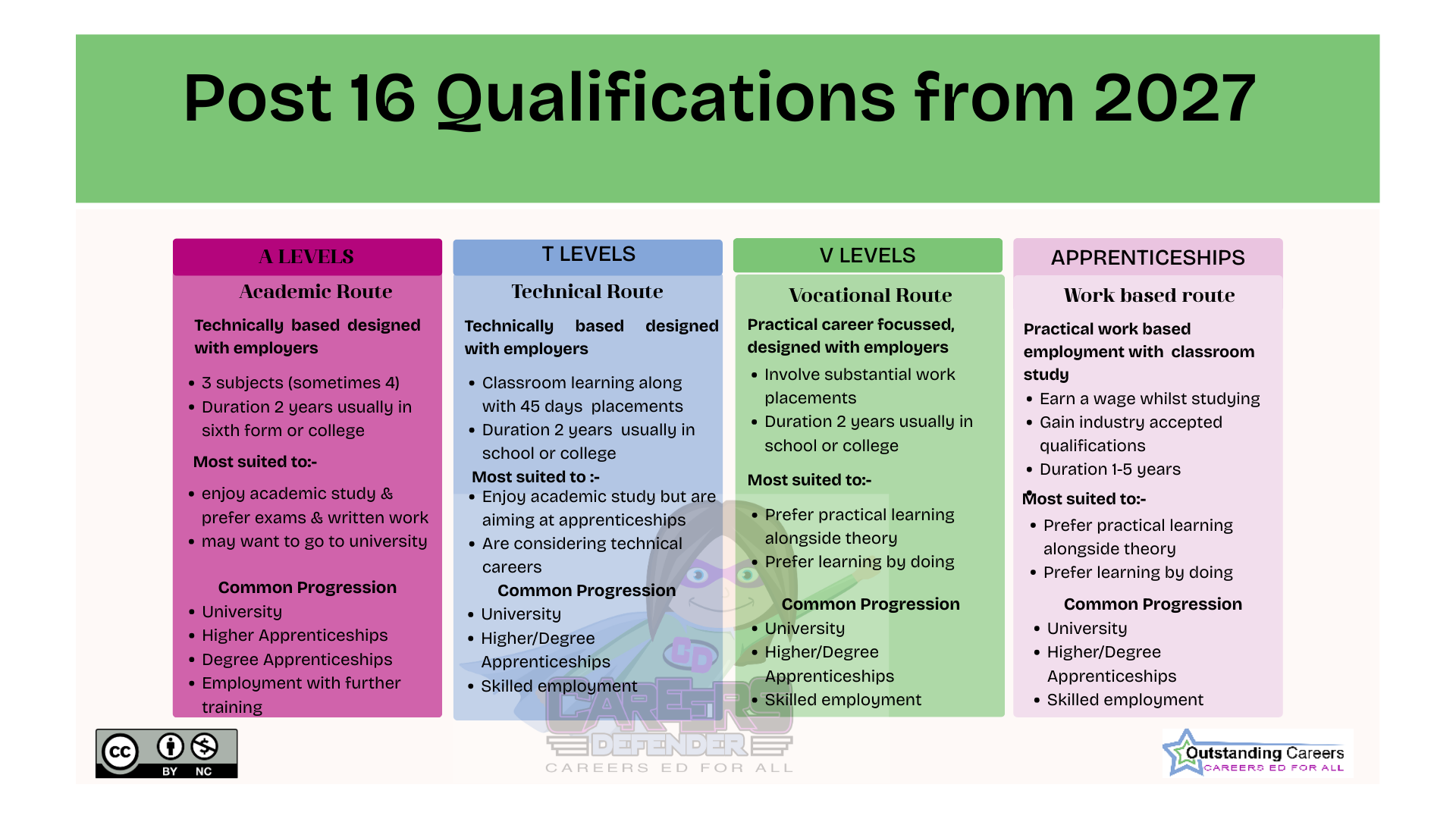
One well-known option is A Levels, which are academic qualifications usually studied at a sixth form or college over two years. Students typically take three subjects and are assessed mainly through exams. A Levels are a common route for students who may wish to progress to university, although they can also lead to apprenticeships or employment.
Another route is T Levels, which are technical qualifications developed with employers. These courses combine classroom learning with a substantial industry placement, giving students practical experience alongside their studies. T Levels are designed to prepare students for technical careers, higher apprenticeships, university or skilled employment.
Students may also consider V Levels, these are a new qualification due to start in 2027. They focus on vocational learning linked to particular industries. These courses emphasise practical skills and applied knowledge, helping students develop experience that is valued by employers. They can lead to further study, apprenticeships or employment in a chosen sector.
Many colleges also offer Applied General qualifications, such as BTEC courses. These combine coursework, projects and some exams, and can be equivalent to one, two or three A Levels depending on the size of the course. Students who complete these programmes often progress to university, apprenticeships or employment.
Finally, some students choose apprenticeships, where they work for an employer while completing training and gaining recognised qualifications.
It is important to remember that there is no single “best” route. Different pathways can lead to the same destinations. Supporting your child to think about their interests, strengths and preferred learning style will help them choose the option that is right for them.